Because of the exponentials, the state of the art changes every week. The frontier models of six months ago are not the ones you should judge by. The only way to keep a useful picture of it is to spend time with the frontier models yourself. Reading about them is not enough.
The hardest part to picture is what a 2023 study by BCG and Harvard researchers called the jagged frontier. AI is excellent at some tasks and bad at neighbouring ones that look just as easy. I draw it as expected performance against actual performance. Voice assistants like Siri sit in the frustrating corner: we expect them to be smart, and they are not. ChatGPT in late 2022 and AlphaGo against Lee Sedol in 2016 sit in the opposite corner, where the system did far more than anyone expected. Even the people who build these models are surprised by what they can do.
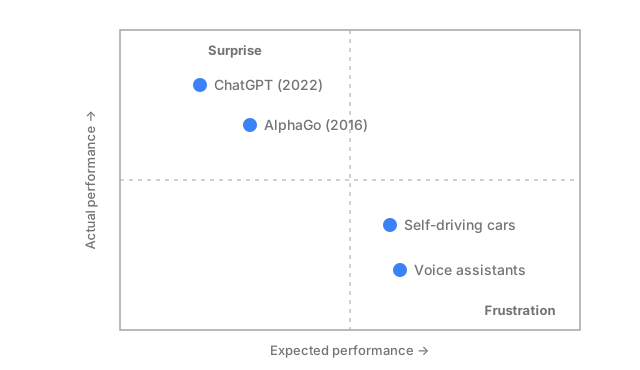
Image models are the easiest place to see the frontier move. Midjourney and FLUX now make photos that fool almost everyone, and Google's image models follow complicated instructions. Video went from the infamous clip of Will Smith eating spaghetti to clips you cannot tell apart from footage within about a year. Robotics is next: the hardware has been good for years, but the software could not learn. Language models changed that, which is why nearly every AI lab now has a robotics project.
The examples in this chapter date fastest. In the 2024 recording they are FLUX 1.1 and Figure's GPT-powered robot. The 2026 deck uses Nano Banana and Atlas. The point stays the same: whatever you saw six months ago is no longer the edge.
Since 2024
The frontier moved from pictures to work. Reasoning models arrived in late 2024, and METR measured the length of tasks AI agents can finish on their own doubling about every seven months. Video models now add sound and keep characters consistent from shot to shot.
Sources
- Dell'Acqua et al., Navigating the Jagged Technological Frontier (2023)
- AlphaGo versus Lee Sedol (2016)
- METR, Measuring AI ability to complete long tasks (2025)