"Agent" is the fuzziest word in AI right now. Microsoft renamed its copilots agents, and vendors now talk about virtual employees. The definition I use is older than the hype: an agent is a system that perceives its environment, makes decisions and acts on that environment to reach a goal. What makes it an agent is the feedback loop. It looks at the result of what it did and adjusts until it gets where its owner wants it.
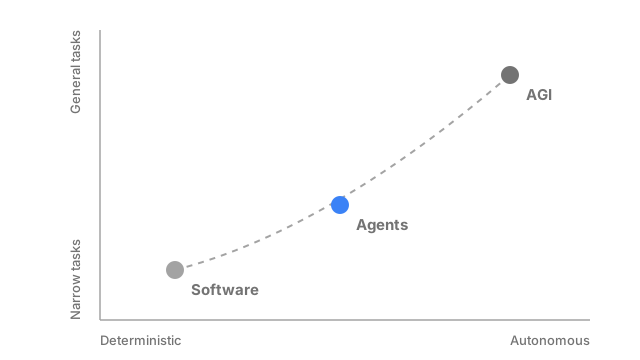
To place agents, I use two axes. One runs from deterministic to autonomous: does the system do one thing in one predictable way, or can it find its own way? The other runs from narrow tasks to general ones. A spreadsheet is deterministic and narrow. It always does what you ask, and it does very little. Agents sit in the middle. Artificial general intelligence would sit in the far corner, autonomous and general. Everyone agrees the map is fuzzy, but there is a strong push to move across it, and that push is worth watching.
Much of the move is about work. A 2023 Goldman Sachs estimate put about a quarter of US work tasks as exposed to automation by AI, and around 40 percent in office administration and legal work. That number will only go up. If you are hiring today, you already weigh what a $20 subscription can do against a salary.
Agents also show up where you don't see them. If you order at a drive-through in the US, you may be talking to Presto, a voice system that handles most orders with no human involved. Waymo's cars drive more autonomous miles every month. Self-driving cars are not everywhere, but they are here.
Try this
Build your first agent. Pick one business problem or personal task that repeats, write the instructions for a custom assistant that handles it, and test it on real cases. It takes about 15 minutes, and you will learn quickly where it breaks.
Since 2024
2025 was the year agents started to work. Coding agents, research agents and agents that use a browser became everyday tools, and the length of the tasks they can finish keeps growing.
Sources
- Goldman Sachs, The Potentially Large Effects of Artificial Intelligence on Economic Growth (2023)
- Presto and Waymo safety impact