Since the 1960s, information technology has doubled in capacity or halved in cost every eighteen to twenty-four months. Moore's law is the famous name for it, but storage, bandwidth, memory and processing follow similar curves. Things get faster faster, and they get cheaper faster. Extrapolate those curves a few years and you get a decent sense of what will be possible. Most tech companies plan this way, and I see no reason to expect the curves to stop.
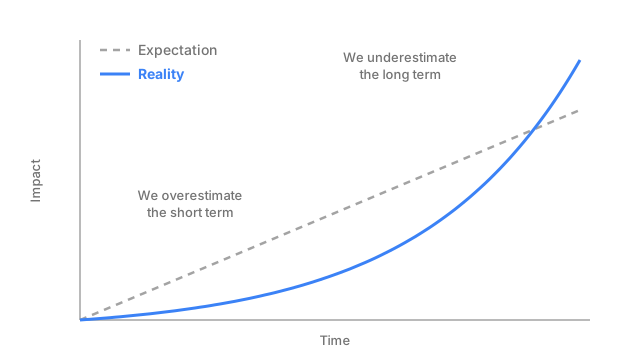
The trouble is that we think in straight lines. Roy Amara put it best: we overestimate the effect of a technology in the short run and underestimate it in the long run. I have used his curve in talks for over a decade because it keeps being true.
Technology also has a direction. It moves toward lower cost, more places and more complexity, and it changes what we expect from the world. We used to hunt when we were hungry. Now we tap. Langdon Winner called our habit of picking up tools without noticing how they change us technological somnambulism, sleepwalking. It works like a ratchet: once a technology is familiar, there is no way back to the world before it.
AI is a general-purpose technology in that sense, like writing, printing, electricity and the internet. These are the technologies we stop seeing because everything else runs on them. AI also sits where computer science, statistics, linguistics, psychology, data science, ethics and mathematics meet. Each of those fields moves at its own pace, and nobody is an expert in all of them. The only thing that has read all of them is the language model.
"AI" is also not one thing. A rice cooker that adjusts to the grain is a reactive machine, like a spam filter or Deep Blue. Predictive AI scores credit and forecasts demand. Generative AI writes and draws. Most of this framework is about the generative kind, but it is only one branch.
Try this
Imagine you had ten times the computing power you have today. What would you do with it, as a business or as a person? Nvidia has asked itself that question for decades. Most of what we do carries limits we no longer notice: the camera in your pocket, how fast you answer a customer, how many options you can compare before you decide. Think a few jumps down the curve and ask what changes.
Since 2024
The curve has not bent. Epoch AI estimates that the computing power used to train frontier models has grown about four to five times a year, and the cost of using a model of a given quality keeps falling.
Sources
- Roy Amara and Moore's law
- Langdon Winner, on technological somnambulism
- Eloundou et al., GPTs are GPTs (2023), on AI as a general-purpose technology
- Epoch AI, Trends in AI