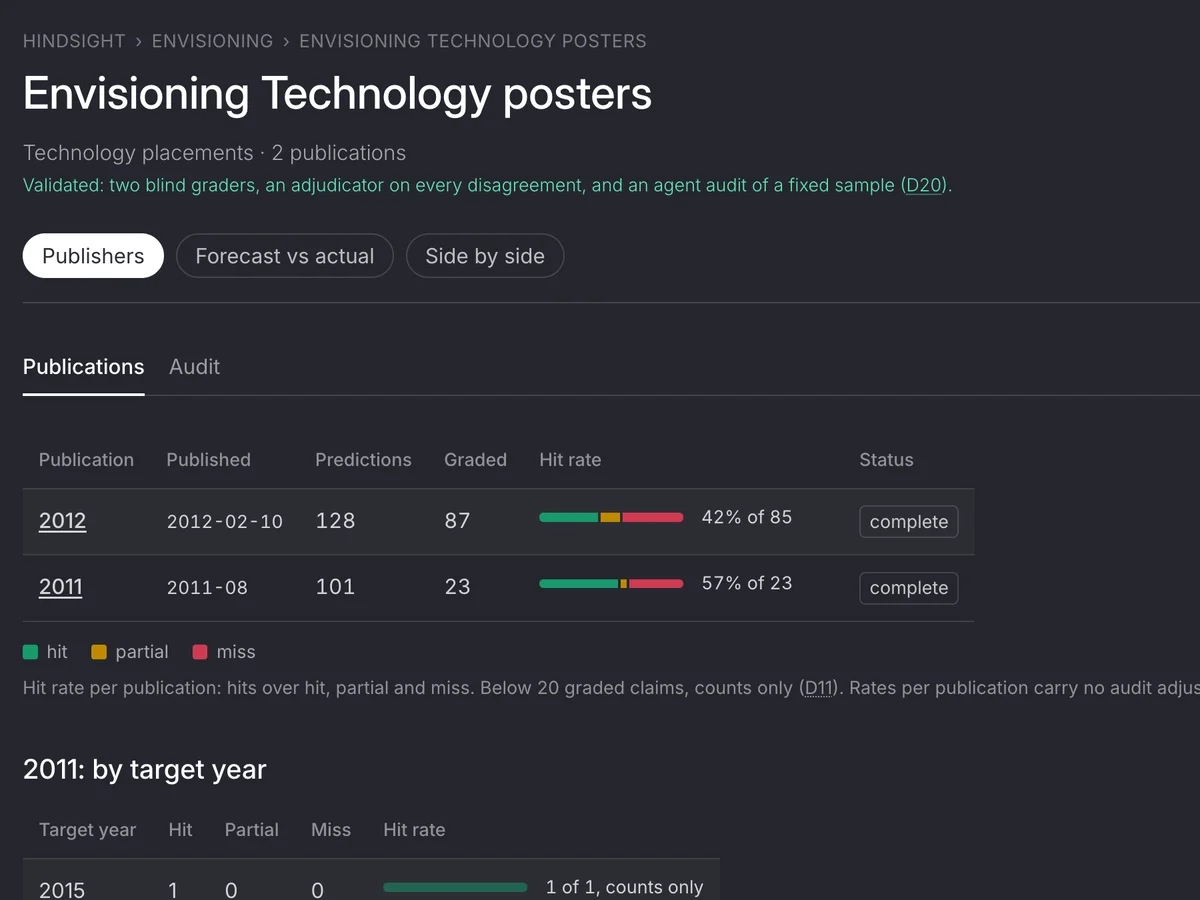
In 2011 and 2012, Envisioning published two posters that placed emerging technologies on a timeline: tablets around 2012, speech recognition around 2015, self-driving cars around 2019, space tourism around 2020. Futurists rarely go back and check. So we did, with the same method we now use for everyone else's forecasts in Hindsight.
The answer: 49 of 108 testable forecasts came true, or 45%. Counting partial hits, 57% held. The honest range, given the sample, is 36% to 55%.
That is exactly the hit rate of Ray Kurzweil's 1999 predictions for 2009, graded the same way. I'm not sure whether to find that flattering or humbling.
How we graded
Each placement on the posters is a claim: this technology becomes mainstream around this year. For every claim, two graders worked separately and blind to each other. Each looked for evidence against a fixed test of "mainstream", such as a share of an industry using it routinely or a share of new devices shipping with it. An adjudicator settled every disagreement, and an audit rechecked a fixed sample of 50 verdicts. The two graders agreed well (kappa 0.75), and the audit found problems with 8% of the verdicts it rechecked.
Some placements can't be graded yet: 39 forecasts from 2012 point past 2026 and are still open. A few were too vague to test, and those are left out of the rate.
Right about bits, wrong about atoms
The pattern by category is stark.
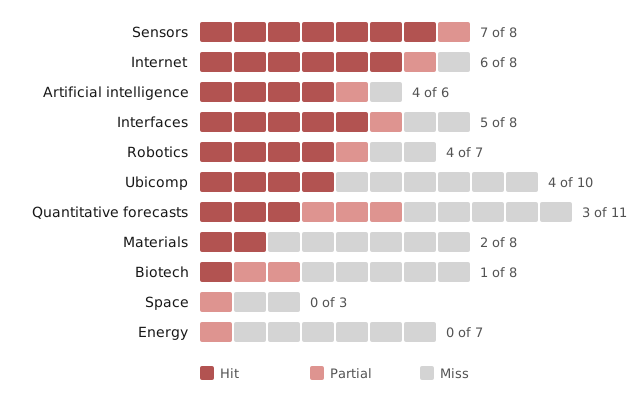
Everything digital did well. Sensors went 7 for 8, the internet 6 for 8, interfaces 5 for 8 and artificial intelligence 4 for 6. We placed cloud computing, multi-touch, near-field communication, speech recognition, machine translation, augmented reality, 4G and 5G about right.
Everything physical did badly. Energy went 0 for 7: tidal turbines, fuel cells, photovoltaic glass and segmented smart grids are all still niche. Materials went 2 for 8, with graphene, metamaterials and self-healing materials still waiting. Biotech went 1 for 8: no printed organs, no synthetic blood, cultivated meat on a handful of menus. Space went 0 for 3.
My reading: software spreads at the speed of a download, while atoms need factories, regulators, supply chains and capital. Our 2012 timeline used one clock for both. It should have used two.
Late, not wrong
Most misses are not dead ideas. They are late. Self-driving cars, which we placed in 2019, now carry paying passengers in a few cities but are far from mainstream. Paid suborbital flights began in 2021, and space tourism still means about a hundred people. Smart glasses failed with Google Glass and are only now coming back.
The quantitative forecasts tell a different story. We got world population and the number of connected devices right. But we extrapolated storage and memory exponentially and badly overshot: we expected a $150 hard disk to hold 200 terabytes by 2020 and standard RAM to reach 750 gigabytes. Typical computers still ship with 16 gigabytes. Exponentials are real, but they don't carry every product along with them.
Why publish this
Because a forecast you never check is a story, not a forecast. Hindsight now tracks forecasts from more than twenty publishers, from Deloitte and ARK Invest to central banks, and Envisioning's own posters sit on the same table under the same rules. Every verdict has its evidence and a permanent link.
The full grading of both posters, claim by claim, is at envisioning.com/hindsight/envisioning/technology. The original 2012 poster is here.